 Image 1 of 1
Your brain takes in roughly 11 million bits of information per second. It consciously processes about 40. What it chooses to notice — and what it filters out — quietly shapes the texture of your life. When we get stuck scanning for danger, cataloguing what's missing, anticipating everything that could go wrong, your brain is doing exactly what it evolved to do.
Drawing from neuroscience, polyvagal theory, somatic practice, and the simple practice of paying attention.
Why your mind resists joy — and what to do about it.
A map of your nervous system that actually makes sense
Practices for growing the witness — the part of you larger than any single experience — learning to witness without being swept away
Develop the capacity to be genuinely present to your own ordinary life.
An honest look at resentment, comparison, and the grief underneath both.
Glimmers, gratitude, and the neuroplasticity of noticing
we naturally notice what's not enough.
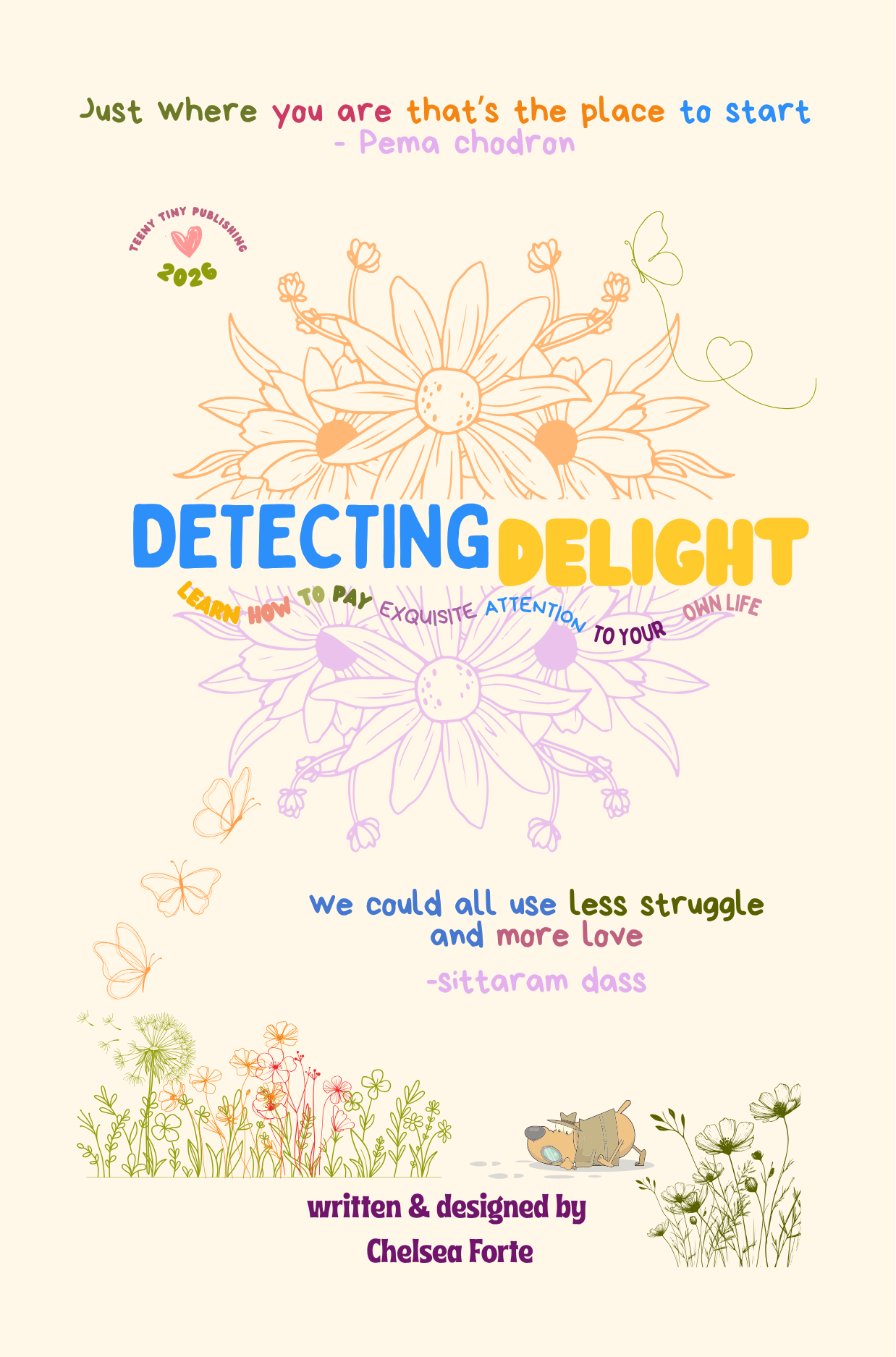
Detecting Delight is a compassionate field guide for retraining your attention. We won’t be forcing positivity, gratitude journals, affirmations or any of the things you already think you should be doing but aren't.
This is a practice of learning to look differently, developing the capacity to pay exquisite attention to your own life - including the hard parts, discovering that delight is never as far away as it seems and that the ordinary is far more extraordinary than your nervous system has had the bandwidth to register.
Growth isn't linear. We spiral. We revisit the same lessons at deeper levels. And we can learn to notice with curiosity instead of judgement, with compassion instead of criticism, with tiny moments of attention instead of grasping for grand leaps of transformation.
Joy is often quiet, mundane, hard to notice.
So let's practice.
Your brain takes in roughly 11 million bits of information per second. It consciously processes about 40. What it chooses to notice — and what it filters out — quietly shapes the texture of your life. When we get stuck scanning for danger, cataloguing what's missing, anticipating everything that could go wrong, your brain is doing exactly what it evolved to do.
Drawing from neuroscience, polyvagal theory, somatic practice, and the simple practice of paying attention.
Why your mind resists joy — and what to do about it.
A map of your nervous system that actually makes sense
Practices for growing the witness — the part of you larger than any single experience — learning to witness without being swept away
Develop the capacity to be genuinely present to your own ordinary life.
An honest look at resentment, comparison, and the grief underneath both.
Glimmers, gratitude, and the neuroplasticity of noticing
we naturally notice what's not enough.
Detecting Delight is a compassionate field guide for retraining your attention. We won’t be forcing positivity, gratitude journals, affirmations or any of the things you already think you should be doing but aren't.
This is a practice of learning to look differently, developing the capacity to pay exquisite attention to your own life - including the hard parts, discovering that delight is never as far away as it seems and that the ordinary is far more extraordinary than your nervous system has had the bandwidth to register.
Growth isn't linear. We spiral. We revisit the same lessons at deeper levels. And we can learn to notice with curiosity instead of judgement, with compassion instead of criticism, with tiny moments of attention instead of grasping for grand leaps of transformation.
Joy is often quiet, mundane, hard to notice.
So let's practice.